January 4, 2024
8 min read
Welcome to the world of online advertising, where every click, view, and impression is the key to success. There are two crucial terms in this vast space - eCPM vs CPM. They play a key role in determining the financial fate of digital content creators and advertisers alike.
Imagine this: you're navigating the dynamic field of online marketing. But suddenly, you come across these acronyms. What are they? How do they affect your digital journey? Fear not! We're taking you on a journey to unlock the mysteries of these two acronyms. These terms may seem technical. But we'll break them down into bite-sized pieces, making the complex world of digital advertising easier to understand.
So, fasten your seatbelts. Let's walk through the fascinating metrics that determine the heartbeat of online advertising.
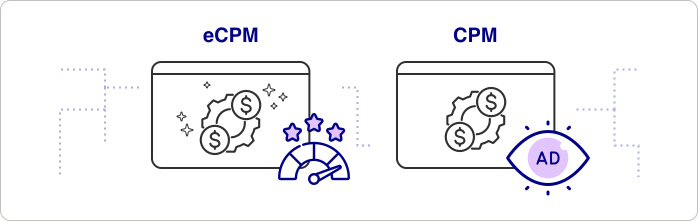
In the evolving field of online advertising, you'll often see the terms eCPM and CPM. But they are often entangled in a web of confusion. Well, these terms have some things in common. They can be confusing to even the most seasoned marketers. They belong to the realm of advertising pricing models. And, of course, they are meant to quantify the value of ad space.
However, the subtle differences in their values are often lost in the general clutter. It leads to confusion. Before we get into the details, let's understand the original problem. Let's find out the meaning of these terms in all their glory.
eCPM, or effective cost per mile, is like a digital yardstick for advertisers. It measures how much money they make for every thousand impressions their ad receives. Picture it as a digital scorecard revealing the financial performance of ads. The "effective" part considers all kinds of ad formats, making it a versatile tool for advertisers to gauge their success. Whether it's a click, view, or interaction, eCPM rolls them all into one neat number. So, the higher the eCPM, the better the ad's financial game. It's like a performance grade that helps advertisers fine-tune their strategies and make the most out of their online presence.
CPM, or cost per mile, is a simple but essential concept in online advertising. Think of it as the price per thousand views of an ad. Advertisers use CPM to estimate the cost of getting a thousand viewers to pay attention to their message. It is similar to determining a budget for a mass audience. It allows advertisers to estimate costs and plan their campaigns accordingly. Looking at eCPM vs CPM, CPM focuses solely on impressions. It counts the number of times an ad is shown, regardless of the number of clicks and interactions. This simple metric is the cornerstone of ad pricing. It helps advertisers navigate the vast digital landscape. It provides a precise estimate of the costs associated with broad audience reach.
Let's dispel the fog and identify the critical differences between these two terms. Of course, these acronyms may seem similar to each other. But in the field of online advertising, they have a special meaning.
Understanding their unique role is akin to having a digital marketing roadmap. Both acronyms measure the cost per thousand impressions. However, eCPM takes a more comprehensive approach, considering different interactions, clicks, and formats. CPM, on the other hand, adheres to fundamental principles. It focuses solely on the cost per thousand ad views.
Therefore, one should remember that their differences are like signposts when embarking on the research. They guide advertisers through the intricacies of the advertising journey.
In conclusion, navigating the digital advertising landscape is becoming more apparent. But the most important thing is understanding the differences between eCPM and CPM. Think of them as essential tools in a marketer's arsenal. And each has a unique role to play.
As you move through the dynamic landscape, remember that eCPM accounts for different interactions and clicks. It provides a holistic view. CPM, on the other hand, sticks to a base cost per thousand views.
As a reliable guide, understanding these metrics helps advertisers like Adelion. We can fine-tune our strategy for optimal online success. So, armed with knowledge, we can confidently chart your course in the vast world of digital advertising under Adelion's guidance.
You might also like: